In the U.S., iodine is somewhat taken for granted. However, it’s an important thing to keep an eye on because globally, iodine deficiency, especially during pregnancy and the first few years of life, is the leading cause of intellectual impairment.
In this episode of Ask the Mayo Mom, we’re talking with Dr. Elizabeth Pearce to learn more about iodine and how we can help make sure our iodine levels support growth and intellectual development.
Read the Transcript:
Dr. Angela Mattke: Hi! I’m Dr. Angela Mattke, a pediatrician with Mayo Clinic in Rochester, Minnesota, and I specialize in helping parents make sense of medical issues. On each episode of Ask the Mayo Mom, we talk to different medical experts to get the latest pediatric research and recommendations.
This episode – iodine IQ.
Is iodine on your 2024 bingo card? If it isn’t, you’re missing a big event. One that changed the world. And our salt.
Dr. Elizabeth Pearce: We’re coming up on a big milestone. In 2024, all of us need to be celebrating the centennial of salt iodization in the U. S.
Dr. Mattke: That’s a huge fact. Why is that so significant?
Dr. Pearce: According to some economists who have gone back and analyzed standardized test scores from before salt iodization in the 1920s to after, that probably the portion of the United States that had the worst iodine deficiency, average IQ in the population increased 10 points, which is enormous.
Dr. Mattke: An average IQ increase of 10 points is significant. For some individuals, 10 IQ points could make the difference between being categorized as having low average intelligence or borderline intellectual disability. It could affect what someone’s able to do independently as an adult, like living alone, having a job, and things like that. And that’s all the power of one nutrient!
Dr. Pearce: That drives not just individual health outcomes, but it drives whole societies, whole economies. Globally, over the last three decades, we’ve estimated that salt iodization, so preventing iodine deficiency, has translated into a 33 billion global economic benefit.
Dr. Mattke: 33 billion? That’s, that’s insane.
How often do you think about iodine? For some people, that might be never. And for a long time, we didn’t need to. That’s because for about 100 years, iodine has been added to table salt to make sure we’re getting enough.
And as you just heard, iodine can make a big difference for your brain and things like IQ. Especially for young, growing brains. Getting enough iodine — or not getting enough — can change a kid’s life.
But, how we eat is changing. Not all of us are cooking or filling our salt shakers with iodized salt. So where are we getting iodine these days? Are our kids getting enough to grow healthy brains and bodies? Can they get too much?
To answer these questions, we’re talking with Dr. Elizabeth Pearce. Elizabeth is a Professor of Medicine and Endocrinologist at Boston University School of Medicine and Boston Medical Center. She also is an expert in iodine deficiency. Thanks so much for joining us, Elizabeth!
In the U.S., iodine has kind of been off the radar for a while, largely because iodine deficiency isn’t particularly common in the United States, but it hasn’t always been that way. What has changed?
Dr. Pearce: To put this in perspective, we think way, way back in geologic time, the Earth’s crust probably had a stable amount of iodine in most places, but over eons and eons, mountainous regions, floodplains, places where there’s been glaciation that kind of scraped the soil off the surface of the earth, they’ve removed iodine from soil in a lot of parts of the world.
And when there’s not iodine in soil, and if you eat locally, which, until recent decades, everybody ate food that was produced locally, you will not have iodine in the food you’re ingesting, you know, meat products, dairy, vegetables. So, you will be iodine deficient.
And so historically, there was a whole portion of the United States, the whole upper northern portion with epicenters in the Pacific Northwest and around the Great Lakes — where you are at the Mayo Clinic was actually right smack dab in the middle of this — that was considered the goiter belt and goiter is just thyroid enlargement. It’s a visible sign of severe iodine deficiency that there’s just a sort of big disfiguring mass on the front of the neck. This would have been a very visible and very common public health problem a hundred years ago in much of the United States.
And what wasn’t really appreciated until some years later was, it’s not just goiter, it’s not just this disfigurement, but also because iodine is important for brain development in early life, probably resulted in impaired intellectual development in a wide proportion of people in the country.
So that was the background. And in the 19-teens, a study was initially done that really for the first time people understood that the reason for this goiter that they saw in these parts of the world was a lack of iodine in the diet. And starting in the 1920s, again 1924 in the U. S., iodine was added to salt as a way of preventing iodine deficiency.
And that was picked because pretty much everybody across all populations ingests a fairly stable amount of salt day-to-day, so it was an easy way to reach the whole population. And after that was done, the goiter belt ceased to be. After about two decades, by the 1940s, it was gone.
And people have forgotten that. I think that’s been lost. People don’t know why there’s iodine in salt anymore.
Dr. Mattke: Oh, that’s a great reminder. Thank you for sharing that. So what is iodine and how does the body use it?
Dr. Pearce: So it’s a chemical element. Again, it’s found in the environment. It’s found in foods we eat. And it’s only known use, as far as we know, in the human body is in making thyroid hormone. But thyroid hormone turns out to be pretty important.
It regulates metabolism, kind of regulates how energy is used in the body at all age ranges. But thyroid hormone is particularly important in what’s sometimes known as the first thousand days — so, that time between conception and the second birthday for a child — when there’s a period of rapid brain development and adequate thyroid hormone and, therefore, adequate iodine nutrition is really important for that to work the way it’s meant to.
Dr. Mattke: So, I understand from what you’re saying that our bodies need iodine to help make thyroid hormone. So how much do we need to get adequate amounts of iodine for our thyroid and our brain and all the other things that are really important, especially for little baby development?
Dr. Pearce: So the amount of iodine we need in order to maintain normal thyroid hormone production is going to change across the lifespan. It is going to be lower in infants and children. Adults have an RDA, so a recommended daily allowance of 150 micrograms a day. Micrograms are a tiny amount, so you don’t need very much, but you do need it.
That’s higher in pregnancy. So pregnant women need about 250 micrograms a day because they’re making more thyroid hormone in a normal pregnancy, and they lose more iodine in the urine and a normal pregnancy. And women who are breastfeeding actively secrete iodine into breast milk, where it’s important for the nutrition of the breastfed infant.
So they also continue to have those higher iodine requirements about 250 micrograms a day for a woman who’s breastfeeding.
Dr. Mattke: Is there a particular window that women really need to focus on the importance of making sure they’re getting adequate iodine, as it pertains to that critical period of brain development for the fetus and then for the child after they’re born?
Dr. Pearce: So in an ideal world, we would want all women to go into pregnancy having had a pretty good amount of iodine in the diet coming in because some iodine can be stored in the thyroid and that gives them little bit of a buffer. There’s some iodine there that can be utilized. So ideally, we would want people to maybe start focusing on that iodine supplementation, if it’s a planned pregnancy, about three months preconception, taking that prenatal vitamin that has the iodine in it.
Probably the most critical window for that effect of iodine on the fetal brain from epidemiologic studies is really in early pregnancy. It’s up till about week 14, so that first trimester is probably particularly significant, which is why ideally we’d want the iodine intake to be optimal even before pregnancy starts, but certainly as soon as a woman who knows she’s pregnant, if it’s not started before, to start that prenatal vitamin with iodine as soon as that pregnancy is diagnosed.
And it’s not that it stops being important, it continues to be important, really right up through, all of life to have iodine, but probably right through adolescence as the brain is developing, but during the most critical period, the earliest time in life.
Dr. Mattke: So the first thousand days is really important for brain development. But beyond that thousand days, is iodine more specifically just really important for thyroid function, growth, and all the other things that thyroid is important for, or is it still important for brains in children that are older and adults?
Dr. Pearce: In school-aged children, we know it’s still important for brains. In some parts of the world that have fairly significant iodine deficiency, randomized trials of optimizing iodine nutrition have shown increases in IQ, even in children who are 9, 10, 11, 12 years old. So there is still some effect that is reversible if iodine is given later in life.
And for adults, where the brain is presumably, more fully developed, you can still sort of get what people describe as brain fog when thyroid hormone levels are too low, that’s a fairly common symptom of hypothyroidism. But probably in adults and older individuals where we feel that the primary development of the brain has been complete, then we’re worried more about metabolic aspects of thyroid health and iodine intakes.
Dr. Mattke: So iodine: it’s a chemical element that our body needs to make thyroid hormone. And thyroid hormone is super important. It regulates how energy is used in the body, and that includes brain development.
Everyone needs iodine, but it’s especially important for kids — and pregnant and breastfeeding parents — during the first thousand days. That’s from conception to a kid’s second birthday. Having enough thyroid hormone during this time is crucial to early childhood brain development.
So, we know what we need iodine for, but let’s figure out if we’re getting enough.
With all that being said, is there a general risk right now of iodine deficiency resurgence to be occurring in the United States? And before you had mentioned like certain geographic regions that were a little bit higher risk, are there certain groups of people that are at higher risk than others?
Dr. Pearce: Yeah, by the 1940s, the goiter belt was gone and people don’t really worry a whole lot about iodine nutrition in the U. S. for a number of decades. The first time it was assessed at the national population level was in the early 1970s, and at that time, based on urinary iodine concentrations across the U. S. population, as a country, we’re probably getting a little more iodine than we even needed. So nobody worried about it again for another 20 years. And then in the early 1990s, a national survey was done for the second time, and much to everybody’s consternation, our iodine intakes in the country had dropped by about half over that 20 year interval.
So there’d been a huge decrease in what people were ingesting, partially maybe because of new awareness about health hazards of salt, partly maybe because people just don’t know why salt is iodized anymore and aren’t reaching for that iodized salt at the supermarket shelf, and also maybe partly due to some shifts in the commercial bread baking industry and in practices for dairy farming.
And the population was still overall and still has been overall kind of at an optimal iodine level. As a country we’re not considered iodine deficient, but unfortunately the group that’s most likely to have low iodine intakes is women of reproductive age and pregnant women. And it’s the pregnant women who need the iodine the most because of the importance of that iodine for the fetal brain.
So we’ve seen in the last 10 to 15 years specifically that pregnant women have become mildly low for iodine intakes in the U.S. We’ve also seen in the last 10 years sort of increasing body of evidence that even that mild iodine deficiency may cause measurable decreases in child IQ, so it may be enough to impact brain development.
Dr. Mattke: So obviously we don’t want to impact brain development because that can affect intellectual abilities. So, if a person, has intellectual impairment and it’s caused by iodine deficiency, how is that diagnosed?
Dr. Pearce: So there’s a challenge because we don’t have a biomarker. We don’t have a blood test or a urine test that can really define a person’s chronic iodine status. That we use urine iodine at the population level to kind of assess iodine nutrition, but urine iodine varies hour to hour, day to day. It’s up and down all the time, and so to really understand an individual’s kind of habitual iodine intakes by testing, we need twelve 24-hour urine samples and I’ve personally never met a patient who wanted to actually do that. It’s completely impractical.
Dr. Mattke: Sounds horrible.
Dr. Pearce: Yes. So, we don’t have an individual biomarker. And therefore, often the recommendations around iodine nutrition are really about prevention and prevention at the population level.
There are some clues, though. So people we know who don’t ingest iodine salt and who don’t ingest dairy are probably at reasonably high risk for low iodine intake in the U.S. because we think those are our two major sources. We know in the U.S. based on small studies and also in other countries, that people who follow restricted diet — so, for example, vegan diets where you don’t have the dairy food — if there’s also not iodized salt, that’s a group of people who might be at particularly high risk for not getting enough iodine in.
Dr. Mattke: Are there signs that a parent should be on the lookout for that would suggest that their child may be experiencing iodine deficiency?
Dr. Pearce: Only the most severe iodine deficiency really is going to manifest as clinical symptoms, and that would probably be detected by thyroid blood testing, but for the vast majority of the population, where we’re not talking about vanishingly small iodine intakes, but levels that are maybe just not quite enough, they’re not going to be specific signs for this. So it’s really being alert to what is in the diet, and adding iodine-containing foods if you think there’s risk, or adding a supplement in some groups.
Dr. Mattke: I’m literally like thinking through my pantry right now and like making sure that my family is getting iodine as we’re talking. And myself, I’m like, okay, I’m going to have a seaweed snack tonight when we get home. But one of the questions that I do have is about too much iodine. You mentioned that as they looked at levels in the population at one point, they thought maybe the population was getting a little too much iodine. Is that a concern and were there risks for that or are there risks for too much iodine?
Dr. Pearce: There are, so be a little careful about your seaweed snack when you go home. But as for most nutrients, too little is concerning and too much can also cause health problems. You know, from a global public health perspective, we’ve been much more concerned about low intakes than high intakes historically, but too much iodine actually also can impair thyroid function, and can also cause goiter, so can solve some of the same problems that very low intakes can.
And so the recommendation is in the U.S. that for adults not to exceed 1100 micrograms of iodine as sort of a usual daily intake, remembering that the RDA is only 150 outside of pregnancy. In children, that RDA is going to be a little bit lower and in pregnancy where we’re a bit more concerned about the effects of iodine excess in the fetus, there may be sort of a narrow window to get this just right and it’s recommended not to exceed 500 micrograms of iodine a day.
It can be a little hard to know what you’re getting just because iodine is not usually listed on package labels. So, one note is that the Office of Dietary Supplements at the National Institutes of Health has a patient website with an iodine fact sheet that does list sources of iodine in the diet, which can I think be very helpful for consumers.
Dr. Mattke: And I’m reading here that typically, one-half to three-quarters of a teaspoon of table salt that does have iodine added to it will have about 150 micrograms of the recommended amount for adults in it.
Dr. Pearce: Exactly. So you don’t need a whole lot of salt to get your iodine from iodized salt in the U.S. And it might also be worth noting that it’s hard to get to really serious iodine excess without either ingesting a supplement that contains way too much iodine, and though some of those are on the market, you need to be careful, or, really high consumption of seaweed. Otherwise, sort of eating a fairly usual U.S. diet, it’s going to be hard to get to that excessive level.
Dr. Mattke: So as a society, we’re still getting enough iodine, but our collective intake is dropping. We still don’t 100% know why. But some theories are that people are trying to eat less salt, people might not be choosing iodized salt anymore, and different food production industries might be changing their practices.
The tricky thing with iodine is that mild deficiencies don’t have symptoms that are easy to recognize. So, the easiest solution is to make sure you’re getting enough iodine in the first place. And it turns out getting the right amount isn’t hard! Let’s find out how to do that.
So are most of us getting our iodine from salt, or do we get it from other places as well?
Dr. Pearce: Iodine is in salt. That’s globally the preventative health measure that we’ve used in most parts of the world to prevent iodine deficiency. We’ve never mandated salt iodization in the U.S. It’s always been voluntary and not all of our salt supply at this point is iodized. That’s of course not the only place we can get iodine, and perhaps it’s not even the most important place in the United States where we’re getting our iodine these days.
So iodine is also found naturally in some foods, highest in seafood, especially saltwater seafood, very high levels in seaweed, although that’s not a major component for the diet for most Americans, and probably the most common source of iodine in the diet these days in the U. S. turns out to be dairy foods.
There is iodine in cattle feed to make sure that the cows have adequate thyroid health so they can make plenty of milk. And there’s also iodine used as a cleanser in the dairy industry to clean off cows, to clean off milking equipments, and that actually may be an important source of iodine nutrition actually for Americans.
Dr. Mattke: You mentioned that iodine is added to the cattle feed and stuff. Is there a difference in the iodine that’s added to the cattle feed in like cows that receive specific hormones or organic milk and stuff? Like, I’m just curious if the iodine should be sufficient in all different types of milk, whether it’s select, non RBST, whatever it is.
Dr. Pearce: Yeah, the answer is that it’s not different for organic and regular milk. There’s no difference, as far as we know, across whole fat milk, low fat milk, organic versus non organic.
Dr. Mattke: So cow’s milk dairy is a really important source of iodine in the United States. But a lot of people are also drinking dairy alternatives, like nut based milks or other things. Do those have iodine in them?
Dr. Pearce: They contain almost none. So it’s really important to know that from an iodine nutrition perspective, almond milk or soy milk is not going to really provide any iodine at all. If it’s cow’s milk, it should contain a reasonable amount of iodine, but the cow’s milk substitutes don’t.
Dr. Mattke: Should Americans actively be purchasing salt that has iodine added to it or do you feel that with iodine in the dairy supply in the U.S. that most Americans are getting their RDA, or recommended daily amount of iodine?
Dr. Pearce: So I’d recommend to anybody who is using salt in cooking or who’s going to be adding salt to food at the table, just make it iodized salt. There’s a real health benefit. There’s really no downside. Unfortunately, about 50 percent of the table salt sold in the United States right now is not iodized and things like the fancy salts, the Himalayan pink salt, the sea salt, and the kosher salt, most of those are not iodized.
Dr. Mattke: I’m literally, like, my husband loves the fancy salts, like some Hawaiian salts, some Himalayan salts, I don’t know. We have weird salts in our salt shaker. But I do have iodized table salt that I add to all my recipes, you know? I’m just thinking we just need to get rid of the fancy stuff.
So, generally speaking, we know that Americans eat too much salt in our food, and that contributes to a lot of other health problems. But if half of the salt that Americans consume doesn’t have iodine in it then the problem isn’t how much salt we’re eating, but what kind, right? In other words, the answer isn’t just, eat more salt, right?
Dr. Pearce: Yeah. And in fact, half of the table salt isn’t iodized, but the vast majority of salt we ingest isn’t actually table salt. It’s salt that’s found in commercially processed foods and the commercial food processors are actually not using iodized salt. So really, the salt that we ingest that could be iodine is probably only about 10 percent of the sodium that we ingest.
So important to note that nobody in the iodine health community wants people to increase salt intake. Just, if you’re going to ingest salt, make sure it’s salt that’s iodized. And it’s important to note that governments are dealing with these competing health imperatives by working together, by monitoring population sodium intakes and population iodine intakes, and increasing iodine levels in salt as salt consumption has declined, so it requires a little bit of teamwork.
Dr. Mattke: So you mentioned it’s very important for women of childbearing age to be getting adequate amounts of iodine. Are you aware if iodine is present in prenatal vitamins that a lot of women take prior to getting pregnant and during pregnancy?
Dr. Pearce: The problem is it’s not in all the prenatal supplements that are marketed in this country. And in fact, the last time we measured this, it was really only in about 60 percent of them.
Unfortunately, that’s probably the place where we want it the most. And the American Thyroid Association and the American Academy of Pediatrics have both made recommendations that women who are planning pregnancy, so that preconception phase, during pregnancy, and during breastfeeding, when iodine requirements are highest and when the risks for low iodine intake are the worst, that women should be ingesting a prenatal supplement that contains 150 micrograms of iodine. The over the counter ones are actually more likely to contain iodine than ones that are sold as prescription products.
And the prescriptions, you often don’t know exactly what’s in there. So we recommend an over the counter multivitamin, where you can actually look at the label and make sure that 150 micrograms of iodine is really there.
Dr. Mattke: Excellent. Just an aside, I can’t believe that the prescription prenatal vitamins, you don’t have iodine in them.
Dr. Pearce: Yeah. I’ve been working on this for years.
Dr. Mattke: Oh my gosh. So Elizabeth, this was really, really fun and I learned a lot today. Thank you so much for joining us.
Dr. Pearce: My pleasure. Thanks for having me.
Dr. Mattke: So it turns out, making sure your family gets enough iodine is pretty easy. If you’re using salt for the table or cooking, grab that iodized salt off the shelf. Or, you can get your iodine from dairy — any type of cow’s milk will do. Some other iodine sources are seafood and seaweed, but make sure you don’t go overboard with that last one.
And last but not least, if you’re someone who needs more iodine, like if you’re trying to conceive, pregnant, or breastfeeding, make sure your prenatal supplement has iodine. An over-the-counter one is more likely to have it, but always read the labels.
So that’s all for iodine IQ. But if your kid has something else going on… or you have a topic suggestion, send us an email at mcppodcasts — that’s podcasts with an ‘s’ at the end — @mayo.edu, or leave us a voicemail at 507-538-6272, and we’ll see if we can help you out.
Please remember, this podcast cannot provide individual medical advice, and the discussion presented here cannot replace a one-on-one consultation with a medical professional. Plus, then you’ll have someone to talk about this podcast with who isn’t your kid!
Ok. Thanks for listening!
Relevant reading
Men's Health Bundle
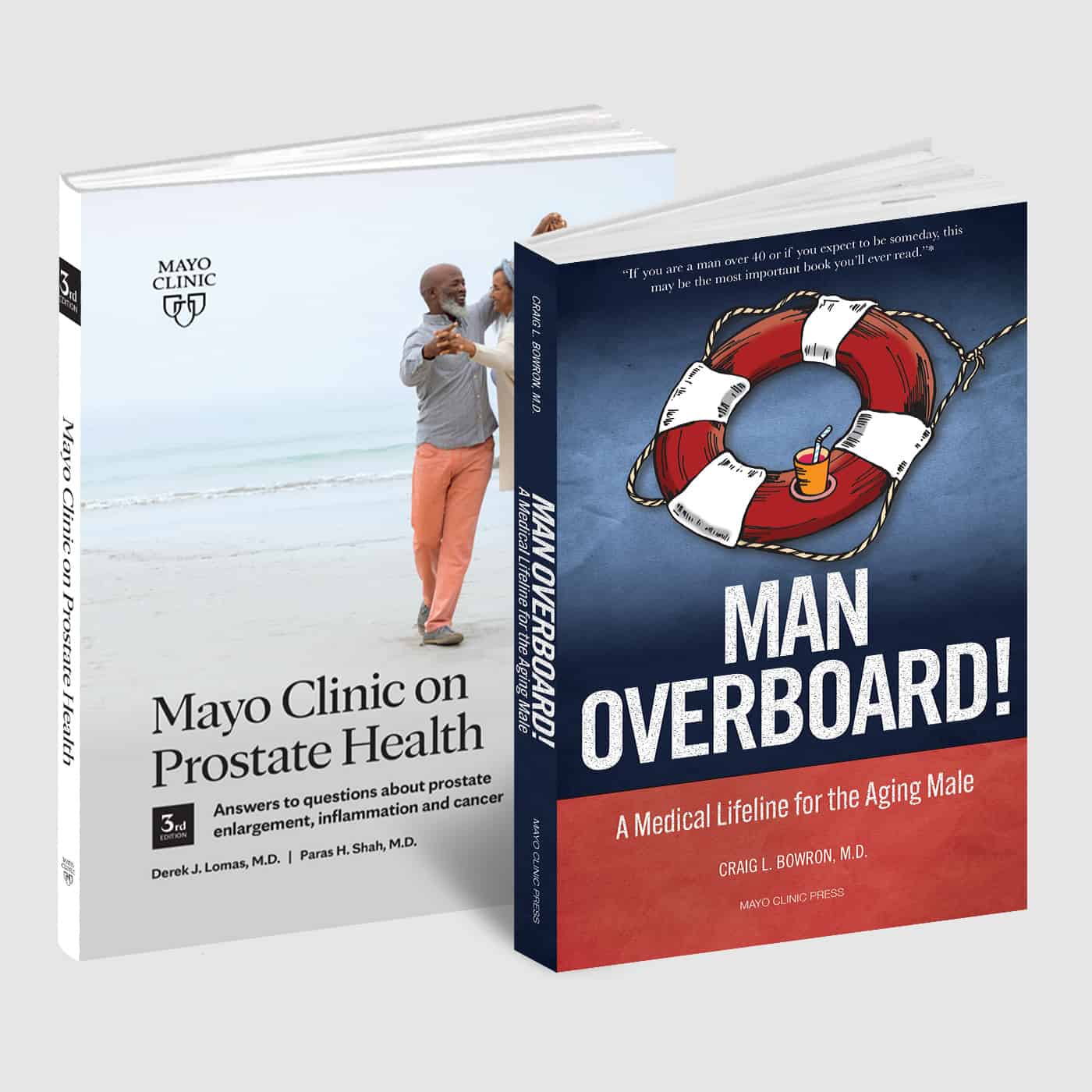
Man Overboard! is a fun-to-read handbook on men’s health is written by Craig L. Bowron, M.D. who uses his years of education and professional experience to help you get through this pilgrimage, this magical journey of aging-while-male, not unscathed but with a sense of control and dignity. You can get…
Want more children’s health and parenting information? Sign up for free to our email list.
Subscribe Open parent optin subscribe modal